
Another experience of the Whisper of God
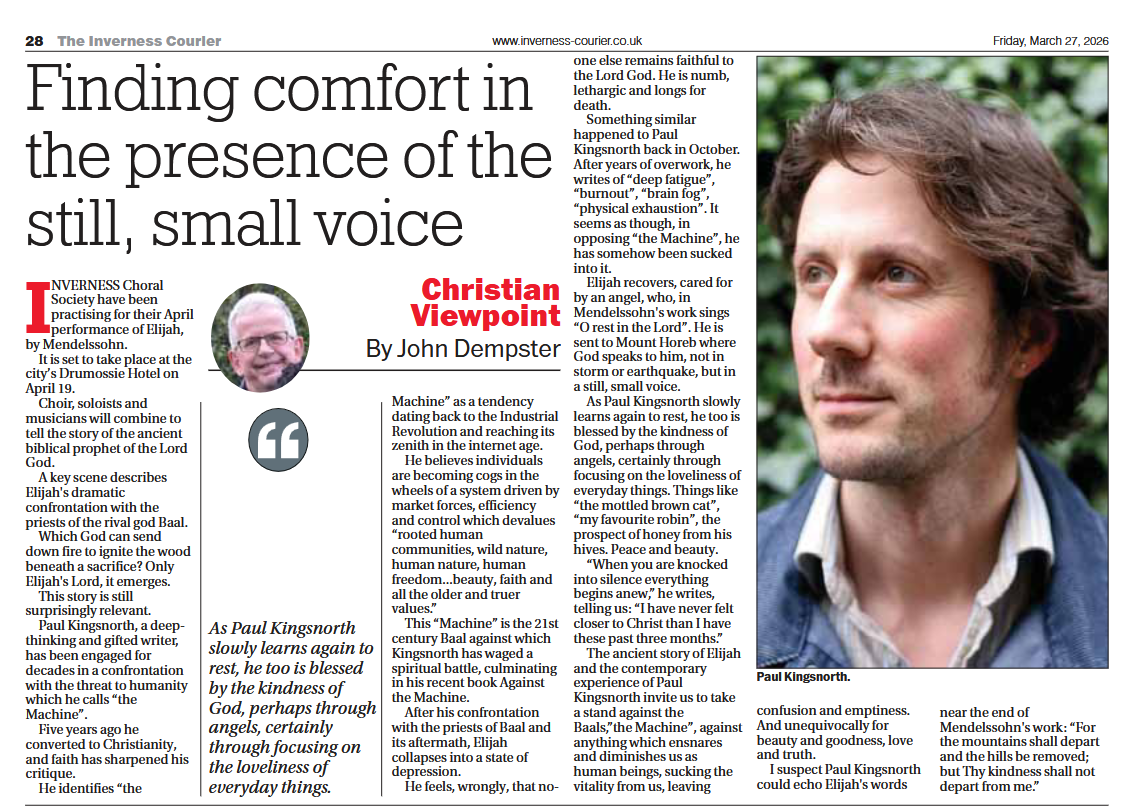
After David’s sermon yesterday – which you can read here – here’s another story of someone else passing through an experience like Elijah’s. It’s from the Inverness Courier, issue dated 27th March.
Inverness Choral Society have been practising for their April performance of ‘Elijah’, by Mendelssohn. It’s at the Drumossie Hotel on 19 April. Choir, soloists and musicians combine to tell the story of the ancient biblical prophet of the Lord God.
A key scene describes Elijah’s dramatic confrontation with the priests of the rival god Baal. Which God can send down fire to ignite the wood beneath a sacrifice? Only Elijah’s Lord, it emerges. This story is still surprisingly relevant.
Paul Kingsnorth, a deep-thinking and gifted writer has been engaged for decades in a confrontation the threat to humanity which he calls ‘the Machine’. Five years ago, he converted to Christianity, and faith has sharpened his critique.
He identifies ‘the Machine’ as a tendency dating back to the Industrial Revolution and reaching its zenith in the internet. He believes individuals are becoming cogs in the wheels of a system driven by market forces, efficiency and control which devalues ‘rooted human communities, wild nature, human nature, human freedom…beauty, faith and all the older and truer values.’
This ‘Machine’ is the 21st-century Baal against which Kingsnorth has waged a spiritual battle, culminating in his recent book ‘Against the Machine.’
After his confrontation with the priests of Baal and its aftermath, Elijah collapses into depression. He feels, wrongly, that no-one else remains faithful to the Lord God. He is numb, lethargic and longs for death.
Something similar happened to Paul Kingsnorth back in October. After years of overwork, he writes of ‘deep fatigue’, ‘burnout’, ‘brain fog’, ‘physical exhaustion’, It seems as though, in opposing the Machine, he has somehow been sucked into it.
Elijah recovers, cared for by an angel, who, in Mendelssohn’s work sings ‘O rest in the Lord’. He is sent to Mount Horeb where God speaks to him, not in storm or earthquake, but in a still, small voice.
As Paul Kingsnorth slowly learns again to rest, he too is blessed by the kindness of God, perhaps by angels, certainly by focussing on the loveliness of everyday things. Things like ‘the mottled brown cat’, ‘my favourite robin’, the prospect of honey from his hives. Peace and beauty.
‘When you are knocked into silence everything begins anew’, he writes, telling us ‘I have never felt closer to Christ than I have these past three months.’
The ancient story of Elijah and the contemporary experience of Paul Kingsnorth, invite us to take a stand against the Baals, ‘the Machine’, against anything which ensnares and diminishes us as human beings, sucking the vitality from us, leaving confusion and emptiness. And unequivocally for beauty and goodness, love and truth.
I suspect Paul Kingsnorth could echo Elijah’s words near the end of Mendelssohn’s work: ‘For the mountains shall depart and the hills be removed; but Thy kindness shall not depart from me.’