
The next week at Hilton Church
Sunday 25th October Nitelife meets in the small hall at 7.00pm
Monday 26th October Rhymes Recollected meets in the small hall, 2.00pm – 3.00pm
Thursday 29th October Book Group meets in the small hall at 7.30pm
Friday 30th October Friday Toddlers, run by Hilton Family Support meets in the large hall (rear entrance) from 10.00am – 11.13am.
Sunday 1st November 10.30am Sunday worship in the church and broadcast live on the church Facebook page


Hilton Parish Church
Sunday 25 October 2026
A worship service was held at 10.30am in the church building on Sunday 25 October. The service was simultaneously broadcast on the Church Facebook page. For the next four weeks, you can catch up here.
The Bible passage is Matthew 22:34-46, and Duncan led and preached before David led us in Communion.
John writes: Despite Storm Boelo gusting vigorously around Inverness, a good number of us made it to the warmth and welcome of Church this morning.
During the service, Duncan mentioned the week’s stormy headlines: messaging encouraging everyone to have at least three days’ supply of essentials at home; concerns over the implications of climate change; the threat of a European war; the economic and political implications of Artificial Intelligence. In prayer, Duncan brought all these concerns to the God in whom we trust.
The sermon was on Matthew 22:34-46: Duncan focussed our attention on Jesus’ teaching in verses 37-39:
‘“Love the Lord your God with all your heart and with all your soul and with all your mind.” This is the first and greatest commandment. 39 And the second is like it: “Love your neighbour as yourself.”’
Duncan emphasised particularly the challenge to love our neighbours, whoever they may be, and in whatever circumstances they may find ourselves. We are called to show a high-quality love not based on our feelings, but on a positive moment-by moment choice to treat well all those we encounter.
It’s the kind of love which flows from our love for God, and in turn our love for God flows from our discovery of God’s love for us.
Duncan quoted Debbie Thomas writing about this passage:
At this point in the story Jesus crucifixion is just days away. Death is literally breathing down his neck, and he is rapidly running out of opportunities to communicate the heart of his message. But when he is asked what matters most in a life of faith, Jesus doesn’t say, ‘Believe the right things’. He doesn’t say, ‘Maintain personal and doctrinal purity’. He doesn’t say, ‘Worship like this’ or ‘Attend a church like that’. He doesn’t even say, ‘Read your Bible’ or ‘Pray every day’, or ‘Preach the gospel to every living creature’. He says, ‘Love’. That’s it. All of Christianity distilled down to its essence so that maybe we’ll pause long enough to hear it. Love. Love God and love your neighbour.
As we took the bread and wine we remembered the action which shows the full extent of God’s love for us – Christ’s death on our behalf. David reminded us how welcome we all are to the table – with all our struggles and failures we are welcome to come and meet Jesus in bread and wine.
I love the way William Barclay put the call to Communion many years ago. (David didn’t use these words this morning, but he echoed their sentiment):
Come, not because you are strong, but because you are weak.
Come, not because any goodness of your own gives you a right to come,
but because you need mercy and help.
Come, because you love the Lord a little and would like to love Him more.
Come, because Jesus loved you and gave himself for you.
Lift up your hearts and minds above your cares and fears and let this bread and cup be to you the token and pledge of the grace of our Lord Jesus Christ, the love of God, and the fellowship of the Holy Spirit, all meant for you, if you will receive them in humble faith.
Whatever the storms thunder around us in our personal lives, in our communities and nation, in the world as a whole, the love of God is where we find security regardless of what struggles we find ourselves passing through.

Here are links to websites which Duncan has recommended we explore:
The Bible Project
The Bible Society
The London Institute for Contemporary Christianity
Here are links to David Sim’s posts on ‘Medium’
All posts
New posts:
Love your enemies. No exceptions (July 20 2026)
The unfolding word: Listening for the heartbeat of the sacred text (August 3 2026)
Faith>Belief (31 August 2026)
Nature speaks of the divine (9 September 2026)
Beyond nature – encountering the divine (14 September 2026)
Blessing: why spiritual defiance starts with your words (11 October 2026)

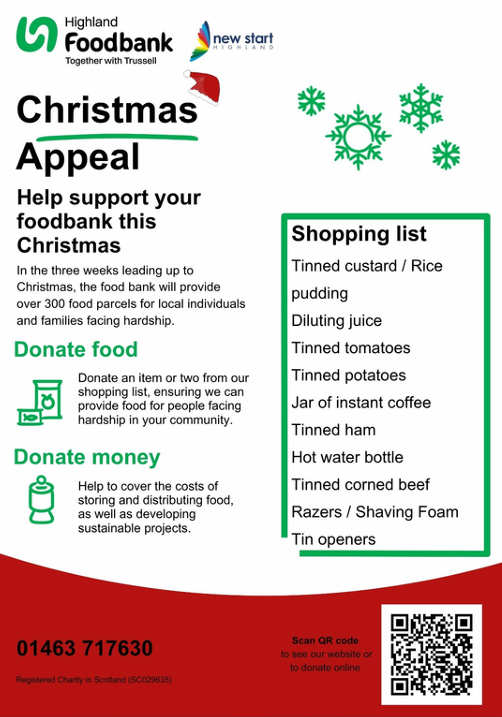
Highland Foodbank would appreciate our help: Harvest Appeal, 2026

Inverness ‘Warm Spaces’
A number of venues across Inverness have opened their doors through the week to offer a warm welcome and bring people together in the local community. Enjoy some Highland hospitality and make new friends. Additional support is also available at some venues.
Here’s a link to a list of these ‘Warm Spaces’ with the times they are available.


Hilton Parish Church works very closely with Hilton Family Support, helping to make a difference in the local community. Click the links below to explore.
Click here for the latest Hilton Family Support Newsletter.
Click here to donate to Hilton Family Support


Giving to Hilton Parish Church
If you would like to give towards the work of Hilton Parish Church, here are a few ways in which you can do it.
(1) The most beneficial way of giving would be through a monthly standing order which would enable the congregation to have a regular and predictable monthly income:
Sort Code: 80-91-26
Account No: 00444375
Account Name: HILTON CHURCH
(2) You can also give through the Give.net link below
(3) Free Will Offering Envelopes – we are conscious that many may wish to continue with this scheme putting money aside each week, and we look forward to receiving these offerings when the crisis comes to an end.
(4) If you would like to give offerings through cheque, these can be made payable to Hilton Church and posted to: Hilton Parish Church, 4 Tomatin Road, Inverness, IV2 4UA
Please note that if you are a tax payer Gift Aid is applicable for all of the above and this can increase our income by 25%. If possible, please complete a Gift Aid declaration (available here or from the church office) and return it to the church office.
We thank you for your support of the ministry of Hilton Church.
Our latest Facebook posts

Here's a link to the Bible passage for Sunday's service:
Bible Gateway passage: Matthew 22:34-46 - New International Version - UK
www.biblegateway.com
The greatest commandment - Hearing that Jesus had silenced the Sadducees, the Pharisees got together. One of them, an expert in the law, tested him with this question: ‘Teacher, which is the greates...0 CommentsComment on Facebook
Get in touch
Contact Details
Hilton Church is at 4 Tomatin Road, Inverness IV2 4UA
Tel:
01463 233310
email:
office@hiltonchurch.org.uk
The Care Team
The Care Team’s role is to provide help and support in various ways for people of all ages in the congregation. These could be a home or hospital visit, a meal in time of crisis, or a listening ear.
If you, or anyone you know needs help in this way, please contact
Church Office: 01463 233310
The next week at Hilton Church
Sunday 25th October Nitelife meets in the small hall at 7.00pm
Monday 26th October Rhymes Recollected meets in the small hall, 2.00pm – 3.00pm
Thursday 29th October Book Group meets in the small hall at 7.30pm
Friday 30th October Friday Toddlers, run by Hilton Family Support meets in the large hall (rear entrance) from 10.00am – 11.13am.
Sunday 1st November 10.30am Sunday worship in the church and broadcast live on the church Facebook page
Hilton Parish Church
Sunday 25 October 2026
A worship service was held at 10.30am in the church building on Sunday 25 October. The service was simultaneously broadcast on the Church Facebook page. For the next four weeks, you can catch up here.
The Bible passage is Matthew 22:34-46, and Duncan led and preached before David led us in Communion.
John writes: Despite Storm Boelo gusting vigorously around Inverness, a good number of us made it to the warmth and welcome of Church this morning.
During the service, Duncan mentioned the week’s stormy headlines: messaging encouraging everyone to have at least three days’ supply of essentials at home; concerns over the implications of climate change; the threat of a European war; the economic and political implications of Artificial Intelligence. In prayer, Duncan brought all these concerns to the God in whom we trust.
The sermon was on Matthew 22:34-46: Duncan focussed our attention on Jesus’ teaching in verses 37-39:
‘“Love the Lord your God with all your heart and with all your soul and with all your mind.” This is the first and greatest commandment. 39 And the second is like it: “Love your neighbour as yourself.”’
Duncan emphasised particularly the challenge to love our neighbours, whoever they may be, and in whatever circumstances they may find ourselves. We are called to show a high-quality love not based on our feelings, but on a positive moment-by moment choice to treat well all those we encounter.
It’s the kind of love which flows from our love for God, and in turn our love for God flows from our discovery of God’s love for us.
Duncan quoted Debbie Thomas writing about this passage:
At this point in the story Jesus crucifixion is just days away. Death is literally breathing down his neck, and he is rapidly running out of opportunities to communicate the heart of his message. But when he is asked what matters most in a life of faith, Jesus doesn’t say, ‘Believe the right things’. He doesn’t say, ‘Maintain personal and doctrinal purity’. He doesn’t say, ‘Worship like this’ or ‘Attend a church like that’. He doesn’t even say, ‘Read your Bible’ or ‘Pray every day’, or ‘Preach the gospel to every living creature’. He says, ‘Love’. That’s it. All of Christianity distilled down to its essence so that maybe we’ll pause long enough to hear it. Love. Love God and love your neighbour.
As we took the bread and wine we remembered the action which shows the full extent of God’s love for us – Christ’s death on our behalf. David reminded us how welcome we all are to the table – with all our struggles and failures we are welcome to come and meet Jesus in bread and wine.
I love the way William Barclay put the call to Communion many years ago. (David didn’t use these words this morning, but he echoed their sentiment):
Come, not because you are strong, but because you are weak.
Come, not because any goodness of your own gives you a right to come,
but because you need mercy and help.
Come, because you love the Lord a little and would like to love Him more.
Come, because Jesus loved you and gave himself for you.
Lift up your hearts and minds above your cares and fears and let this bread and cup be to you the token and pledge of the grace of our Lord Jesus Christ, the love of God, and the fellowship of the Holy Spirit, all meant for you, if you will receive them in humble faith.
Whatever the storms thunder around us in our personal lives, in our communities and nation, in the world as a whole, the love of God is where we find security regardless of what struggles we find ourselves passing through.
Here are links to websites which Duncan has recommended we explore:
The Bible Project
The Bible Society
The London Institute for Contemporary Christianity
Here are links to David Sim’s posts on ‘Medium’
All posts
New posts:
Love your enemies. No exceptions (July 20 2026)
The unfolding word: Listening for the heartbeat of the sacred text (August 3 2026)
Faith>Belief (31 August 2026)
Nature speaks of the divine (9 September 2026)
Beyond nature – encountering the divine (14 September 2026)
Blessing: why spiritual defiance starts with your words (11 October 2026)
Inverness Warm Spaces
A number of venues across Inverness have opened their doors through the week to offer a warm welcome and bring people together in the local community. Enjoy some Highland hospitality and make new friends. Additional support is also available at some venues.
Here’s a link to a list of these ‘Warm Spaces’ with the times they are available.
Highland Foodbank asks for our help: Harvest Appeal 2026
Hilton Parish Church works very closely with Hilton Family Support, helping to make a difference in the local community. Click the links below to explore.
Click here for the latest Hilton Family Support Newsletter.
Click here to donate to Hilton Family Support
Giving to Hilton Parish Church
If you would like to give towards the work of Hilton Parish Church, here are a few ways in which you can do it.
(1) The most beneficial way of giving would be through a monthly standing order which would enable the congregation to have a regular and predictable monthly income:
Sort Code: 80-91-26
Account No: 00444375
Account Name: HILTON CHURCH
(2) You can also give through the Give.net link below
(3) Free Will Offering Envelopes – we are conscious that many may wish to continue with this scheme putting money aside each week, and we look forward to receiving these offerings when the crisis comes to an end.
(4) If you would like to give offerings through cheque, these can be made payable to Hilton Church and posted to: Hilton Parish Church, 4 Tomatin Road, Inverness, IV2 4UA
Please note that if you are a tax payer Gift Aid is applicable for all of the above and this can increase our income by 25%. If possible, please complete a Gift Aid declaration (available here or from the church office) and return it to the church office.
We thank you for your support of the ministry of Hilton Church.
Our latest Facebook posts
Get in touch
Contact Details
Hilton Church is at 4 Tomatin Road, Inverness IV2 4UA
Church Office: 01463 233310
email:
office@hiltonchurch.org.uk
The Care Team
The Care Team’s role is to provide help and support in various ways for people of all ages in the congregation. These could be a home or hospital visit, a meal in time of crisis, or a listening ear.
If you, or anyone you know needs help in this way, please contact
Church Office: 01463 233310