
Sunday Service: 26 April 2026
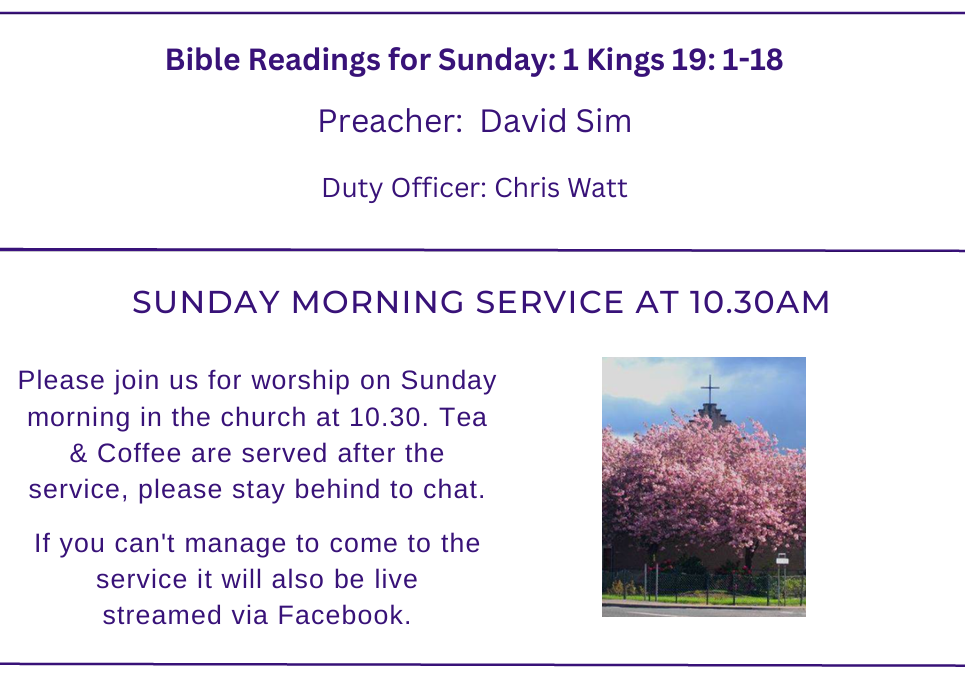
A worship service was held at 10.30am in the church on Sunday 26 April. The service was simultaneously broadcast on the Church Facebook page. For the next four weeks you can catch up here.
The Bible passage was 1 Kings 19:1-18 David Sim led the service and preached the first of a series of sermons on God’s Surprising Love.
Based on the experiences of Elijah in the Bible passage we read today, and with reference to difficult times in his own life, David spoke movingly about the love of God which reaches out to us even when we are at the end of our tether. You can listen on the catch up – the sermon begins at 37:50 in on the video, and you can read the full sermon below. And you can read the story of another encounter with the Whisper of God here.
Here’s the sensitive prayer with which David began the service:
Lord God, we gather today in your presence and we simply want to tell you that we love you.
You have been faithful to your people from the very beginning of time. You’ve been faithful to us in our own lives too, often when we’re unaware of how you’re working. We thank you that you’ve never walked away from us, even if we felt we were at our lowest point.
We think of the people in this church and in our community. You’ve met us in our darkest hours, when we felt empty and had nothing left to give. You fed us and gave us strength. When we felt completely alone and thought that no one could hear us, you were there in the quiet.
You’re amazing, God.
We do not just praise you for what you can do for us, but for who you are. You are kind and merciful, even when we make mistakes. You are patient with us, even when we’re stubborn.
We are so grateful that we can come here today because Jesus showed us the way back to you.
But Father, we want to be honest with you. Our hearts are often closed off. We build walls round ourselves to try and stay safe, but those walls just end up keeping you out. We get trapped by our own fears and our own worries. We get stuck in our own small ways of thinking, imagining that things can never change or that you are too far away to help. We confess we often shut you out when we should be running towards you.
We ask you now to make our hearts bigger. As we come together in worship, please make room in us for your Holy Spirit to move and breathe.
You want to live right here with us, in the middle of our daily mess, in the centre of our community, and in the heart of our families.
Together we say ‘yes’ to that. We invite you in.
Holy Spirit, help us to listen for you. Help us to recognise your voice when you’re speaking. Whether you speak through the Bible, through a friend, or through that quiet gentle whisper, in our own spirits, please make us ready to listen.
We give this time to you. We hand over our plans and our worries.
Let your presence fill this room.
Sermon: The God of the Gentle Whisper
Scripture: 1 Kings 19:1–18
Introduction:
There was a Saturday morning, not that long ago, as I was still drying off after a particularly luxurious shower, when my wife Heather shouted up from downstairs – “The Sunday Times is on the phone… and they’re asking for YOU.”
Now in a way this wasn’t much of a surprise. Clearly a journalist had finally heard one of my sermons online, and was impressed how it had spoken into the contemporary situations plaguing our society. Surely I was about to become a national spiritual hero.
So, not wanting to miss the opportunity, I threw on just enough clothes to be decent, tripped my way down the stairs, and crawled to the phone slightly sore and tangled in my damp dressing gown.
I gasped into the receiver, ‘Hello? David Sim speaking… Is this The Sunday Times?”
And a very polite, Southern English-accented voice on the other end said, ‘Good morning, Mr Sim! We’re calling to see if you’re interested in a digital subscription to The Sunday Times for just one pound a month…'”
It’s too easy to try to be the hero of our own stories. We’ve all had moments when we’ve felt that a lot depends on us, and of course, sometimes we are a critical cog in the machine. But, more often than not, our importance is a weight we were never designed to bear.
I’ve recently been in a period of burnout, or stress, or depression or whatever label you want to put on it, and so today’s Scripture is somewhat personal to me. It’s been a period when I’ve sometimes wondered if God was present. A period when it felt somewhat alone and overwhelming.
And we heard this morning about Elijah, whose strength finally runs out under the broom tree. The black dog prowls around him. Elijah had thought he was the hero of a national revival. After all, just a short while before, he prayed and fire fell from heaven. He prayed and rain came from the sky for the first time in years.
But now… he’s just a man in a cave who just wants to go to sleep and never wake up.
I. 1 Kings 19:1–4
When we talk about the Hebrew Bible, or the Old Testament, we often think of heroes. Abraham, Noah, Moses, David. And, like each of you here, they all had incredible gifts and opportunities to use them.
But every single one of these heroes were “cracked vessels.” None of them were perfect, and none of them were able to succeed without turning, and re-turning, to God.
Elijah too is a man of God, Elijah is a man of profound spiritual insight… yet Elijah has been putting on a performance. And now, in a moment of brutal honesty about his situation, his despair is three-fold:
He is physically exhausted
He is emotionally drained: He feels like a failure. “I am no better than my ancestors” he says.
He is spiritually lost: He feels uniquely alone. “I, even I only, am left”.
We find out soon enough that he is far from alone – there’s at least 7,000 others. But he’s not in a place to realise that.
II. 1 Kings 19:5–9
So how does God respond to a servant who wants to give up?
Rebuke? Strike down? Condemn?
Quote motivational verses from Scripture?
Tell him to “pray harder?”
Question his faith?
Actually… no. God offers Elijah a meal. With great compassion:
“the angel of the Lord came again and touched Elijah and said, “Get up and eat some more, or the journey ahead will be too much for you.””
This is God, this is Christ, the angel of the Lord, in amongst the messy reality of life.
I think many of us are rather afraid of the “Old Testament” God, or at least our image of an angry man with a killer surveillance system. And yet here we have God portrayed as a loving servant. God is inviting Elijah to rest, and to eat. The divine messenger provides “cake baked on hot stones.”
It’s a reminder of just how important the work of Stuart and the hospitality team is to our gatherings here in Hilton!
This is God as a deeply tender companion, caring for Elijah’s mind, body and soul. This is God offering not just bread as food; but the bread of life who sustains us through the hard times.
Talking about misery… and despair… and trials… and problems, I’ve a friend who is a Ross County supporter.
He can’t get to the games but he watches every game of theirs that is on TV.
Now – as a great supporter – he finds their games to be stressful events. And yet he has found a way to watch their games in perfect peace, perfect calm, perfect assurance.
His solution is simple. He records the games and watches them the next day, after he knows the score. He cracks open a beer, sits back… and while he still doesn’t know how the game is going to play out… exactly what is going to happen, to who and when: the fouls, the falls, the misses, the very occasional glory…
he does know the final result.
As Christians, knowing the final score doesn’t always remove the tension of the match. We have little idea about the road ahead and just how bumpy that may be. We don’t know about the physical and mental health, finances, family troubles, church troubles, the losses, the gains, the joys, the triumphs that may come.
But knowing the final score might help us transform HOW we play. We can risk, love, serve, and even fail, knowing we’re playing for a King who’s already won. We’re playing for a King who is always on our side.
And in today’s Scripture, God is about to reveal something to Elijah that will transform how he understands his own struggle and the nature of God’s presence.
III. 1 Kings 19:11–13
After a while, God leads Elijah to Sinai, the same place where He gave the Law to Moses.
Again, we might be surprised by the God of Love we find here.
It turns out God is not found in the wind, the earthquake, or the fire. The fire and earthquake are symbolic of the Law and Judgment, which Elijah was sure would ultimately change God’s people. But in the end, a set of rules and moral judgement cannot change our hearts…
God shows him, and us, that often the most transformative work happens in the “sound of silence,” doing what only the loving whisper of God’s grace can.
It’s genuinely beautiful. It’s through the very presence of silence that God forces us to stop talking and start listening. As the Psalm says…
“Be still, and know that I am God.”
God’s whisper is a presence that fills the void when words could never be enough.
At this point in the story, Elijah certainly isn’t coming to God – indeed Elijah is completely INCAPABLE of coming to God. Thankfully, God’s grace means He takes the initiative to bridge the gap.
So when Elijah runs from God, God still runs after him.
We are blessed today to see God’s gift of Grace in its ultimate form through the life and death of Jesus. The ultimate “gentle whisper” of God occurred when Jesus went silent on the Cross. It happened when Jesus allowed us to hear the whisper of our adoption into God’s family. We are welcomed in, thanks to God’s beautiful love, EVEN if we’re broken, imperfect, cracked vessels.
Maybe ESPECIALLY if we’re broken, imperfect, cracked vessels.
As Leonard Cohen wrote…
There is a crack in everything. That’s how the light gets in.”
IV. Based on 1 Peter 1:6–9
Many of us here and in our community are exhausted from life, loss, addiction, depression, anxiety, family rejection, religious burdens, caring for loved ones, serving others at work and at home.
Sometimes, even showing up for church can feel like a pretty big accomplishment. But showing up is one way that we help make grace real for each other. My healing is bound up in yours, so whenever and however we each show up, God’s love, too, shows up for us both.
And God’s isn’t going to wait till you’re perfect or fixed or you’ve got it together to come alongside you. God doesn’t need you to be pure, or without sin or doubt, before He starts working in your life.
So, what does it mean for God to ‘come alongside’ us, especially when we don’t necessarily feel it? As Elijah found, for most people it’s rarely a dramatic, thunderous event.
More often, God’s presence is found in the quiet, persistent presence within the ordinary. It’s the unexpected strength to face another day, the comfort in a friend’s silent presence, or the small, persistent nudge towards hope when everything feels hopeless. It’s the resilience you discover you have, even when you feel completely broken. It’s the grace that meets you in your honest doubts and questions, reminding you that even those are a form of engagement with the divine.
God is not just outside your pain, but within it, weeping with you, holding you, even when you can’t feel His embrace.
Closing Thought
The God who fed this weary and broken prophet under a broom tree is the same God who died for us on a Roman cross. The God who cares about the physical exhaustion of one man under a bush is the same God who cares about the spiritual rescue of the whole world.
This is the God who cares for you…
He doesn’t love you because you are strong, or perfect; He loves you because you are His. Whether you are in the “fire” of a trial or the “silence” of burnout or loss, know that Jesus is by your side… because you are His. You are part of the family.
I recently heard someone, going through an intense period of grief, say this:
“I know I can walk all the way into my sadness and find Jesus there.”
And if you’re in a season of joy right now, then perhaps your calling is to be a messenger of God, and to be a source of strength for others. Loving our neighbour may be being like Jesus: providing food, or praying, or sitting in silence… just being present.
In Jesus, God came to dwell with us and share our human story. Even the parts of our human story that are the most painful. He wept at tombs. He withdrew from crowds when life pressed too hard. He sweat blood in anguish. He allowed Himself to feel everything we spend our lives trying to outrun.
That’s the God of the gentle whisper. And He’s with you right now.
Amen.
